
about Audio, High Fidelity
& Home Entertainment technologies
pid: 664-2026/11/04 (v1.2)
Privacy Policy
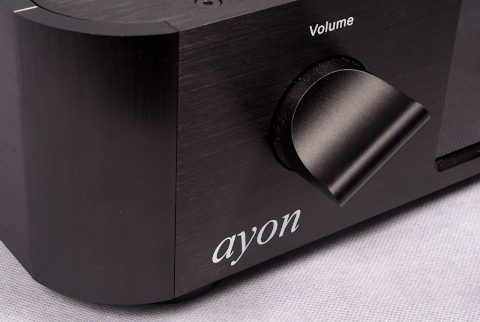
In terms of physical appearance, the Iris is not significantly different from the S3 Junior we reviewed several years ago. A heavy, well-built chassis with rounded edges, a large five-inch color TFT touchscreen, complemented by a monochrome alphanumeric display for basic information, and two jog dials for volume adjustment and input selection, make up a system that looks understated and easy to use, without being... "in your face". That's very much in keeping with the character of all the Austrian manufacturer's products. The user interface is logically laid out and should be easy to navigate even from the start. The only element on the front panel that has nothing to do with operating the unit is a USB-A port, which makes it easy to connect a storage device (a convenient option if you want to use a drive on a temporary basis).

The Iris has what you might call a "classic Ayon" look. This translates into very good build quality and a satisfying feel in everyday use. Most of the front panel is taken up by the two displays, while a USB-A port is available for temporary connections to storage devices.
The unit can also be operated using the conventional infrared remote control or, of course, the dedicated app available for Android and iOS.
Connectivity is quite comprehensive. The streamer can connect to the home network wirelessly via WiFi or through a conventional Gigabit Ethernet/RJ45 port. It also offers standard digital inputs (S/PDIF, coaxial and optical, and AES/EBU), an HDMI port for I2S connection (configurable through the app for maximum compatibility), and a second USB-A port for external storage devices. There is also a coaxial digital output, should anyone wish to use the Iris as a bridge.
The streamer provides access to online services through Tidal Connect, Spotify HiFi, HiResAudio, Qobuz Connect, and Airable Services. It is Roon Ready and compatible with the UPnP/DLNA standard. We had the opportunity to hear the Iris streaming through Tidal at Audio Design's demonstration room, with very convincing results.

The user can make adjustments and select settings either through the touchscreen or the app. In either case, the unit is easy to operate, with a logically structured menu.

The color display shows the file metadata, including the album artwork and file information. A second display provides basic information such as the selected input, sample rate, volume level, and so on.
The connectivity package also includes two single-ended line-level analogue inputs, which have their own signal path to the analogue stage, with no ADC involved.
The output to the next component is available in both single-ended and balanced format. The latter is the native configuration, since the entire analogue stage is balanced, from the DAC outputs through to the attenuator. Given that, it would not have been a bad idea to make one of the two analogue inputs balanced as well. The user can select the output stage gain and can also choose whether to engage the attenuator, using switches. This is essential when the following component does not have its own volume control, as is the case with a power amplifier or an active louspeaker.

The Iris offers a comprehensive set of connections.

Analogue output and analogue input: The unit can also be used as a basic analogue preamplifier.
Inside the chassis, we find a well-organized, high-quality construction, starting with a substantial linear power supply featuring a shielded R-Core transformer, a 2*6.800uF filter bank and 317/337 series regulation. The transformer has separate secondary windings for the digital and analogue circuits, and numerous local regulation stages are used throughout the circuit. The company also mentions that the high-voltage and heater filament supplies employ newly developed circuits. The conventional digital interface uses galvanic isolation transformers for the coaxial and AES/EBU inputs and is based on Cirrus chips, while streaming functions are handled by a StreamUnlimited module (Stream810).
Ayon does not provide much information about the D/A conversion section, merely stating that it uses a dual-mono architecture, with one chip per channel. The internal layout, being multi-board in different levels, does not make these components visible. Third-party online sources report the use of two AKM4493 chips from Asahi Kasei, but this is not confirmed by the manufacturer's official specifications. What we do know is that the two higher-end versions, the Signature and Ultimate, can convert PCM signals to DSD, with the option selectable by the user.
The output from each DAC is kept in balanced form and fed to an analogue stage based on one 6N6P dual triode per channel, operating in Class A without feedback. The company states that the circuit topology here is single-ended, so one can assume that a single triode is used for each leg of the balanced circuit. The analogue attenuator is balanced as well. In the XS version, Mundorf coupling capacitors (polypropylene MKP, from the M Cap series) are used in the output circuit.

The user can select the gain of the analogue stage and choose whether or not to engage the analogue attenuator.

The internal layout is fairly complex. On the left, we can see the power supply, with the R-Core transformer, main filter, and primary regulation stage. The digital circuits occupy the center, arranged across multiple levels, while the analogue stage is visible on the right.

The standard digital inputs are galvanically isolated using transformers (left).

A StreamUnlimited board handles the streaming functions.

The unit's analogue stage is tube-based, single-ended/Class A, and operates without feedback. In this particular version, it uses Mundorf coupling capacitors (M Cap, MKP).
Previous | Next | More Reviews
The .gr Domain
