
about Audio, High Fidelity
& Home Entertainment technologies
pid: 660-2026/10/07 (v1.2)
Privacy Policy
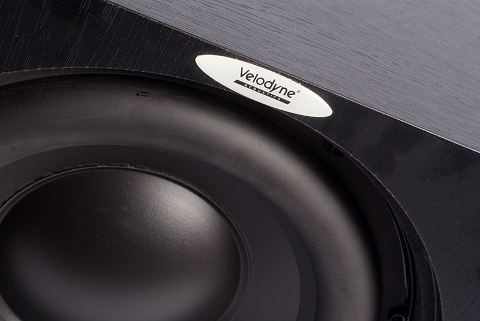
The DB-10 is a sufficiently minimalist construction, whose obvious objective is to blend seamlessly into the listening space and impose no burden whatsoever on the aesthetics. We are dealing with an almost cubic enclosure (296*316*348mm), which rests on elastic support points. The dimensions of the baffle are slightly larger than the diameter of the woofer, and this, in combination with the circular protective grille, creates an interesting visual impression in what is otherwise a well-made yet understated cabinet finished in black.
The enclosure itself is constructed from MDF and is of sealed type, with a baffle thickness of 2 inches (that is, more than 50 mm), and features rounded edges along the depth dimension. The choice of a closed-box loading for the woofer is associated both with improved control at very low frequencies and with the fact that a driver with such a large excursion could generate significant aerodynamic noise from a reflex port—something the manufacturer would then have to manage. In the absence of a port, such an issue simply does not arise.
)
The DB-10 is understated and of relatively small dimensions. The baffle is only slightly larger than the woofer itself, whose suspension allows very large excursions.
When referring to a “long-excursion” woofer, Velodyne appears to mean this quite literally. The driver used in the DB-10 is a ten-inch unit with a reinforced polypropylene cone and a substantial magnetic assembly, which includes a dual magnet, a two-inch voice coil, and a chassis with extensive ventilation capabilities for proper cooling. This approach allows the use of a suspension offering a wide excursion range, providing the subwoofer with considerable dynamic headroom and good low-frequency extension, reaching 28 Hz (–3 dB, anechoic) and 16 Hz in-room, according to the published specifications. The woofer is driven by a linear amplifier with a Class AB output stage, delivering 350Wrms, a figure that, according to Velodyne, can reach up to 850 W peak.
The front-end of the amplifier provides the conventional controls necessary for proper adjustment and integration of the subwoofer within the room and the system. Standard rotary controls offer access to amplifier gain, the cutoff frequency of the low-pass filter that determines the upper extension of the subwoofer, and its phase.
)
The circular protective grille adds character to an otherwise simple construction. The edges along the depth dimension are rounded.
)
The user is provided with a complete set of controls and connection options. The DB-10 can be connected to a line-level output, support systems with a low-frequency effects (LFE) channel, or operate in parallel with the main loudspeakers via its high-level inputs.
Connectivity options are likewise comprehensive. The user is provided with a conventional line-level input, which may be connected to the two-channel (L/R) subwoofer output offered by many devices, an LFE input that may be used with AV processors or integrated amplifiers (in conjunction with bass management menus) to ensure proper reproduction of that channel’s content, as well as high-level inputs that allow the DB-10 to be connected directly to the speaker outputs of a power or integrated amplifier. This type of connection is—according to certain viewpoints—preferable in 2.1 systems intended for music reproduction, as it transfers the sonic character of the power amplifier to the subwoofer and may potentially result in a more homogeneous system. All connectors are of good quality, although Velodyne could provoke a minor criticism, regarding the spring-loaded terminals used for the high-level input. It is true that they do not carry power (the input impedance is very high so as not to load the driving amplifier), but at this price category, one might have expected something better, if only for psychological reasons. On the rear panel of the subwoofer, the user will also find an LFE output (a pass-through for driving an additional subwoofer), as well as the switch controlling automatic power operation. In the absence of a signal for eight minutes, the DB-10 enters standby mode and is automatically reactivated when a signal is again present at one of its inputs.
)
The available controls are those required. The user may select Auto Power mode so that the subwoofer switches on and off automatically.
)
A detail, but an essential one: with this tab, the protective grille can be easily removed.
Previous | Next | More Reviews
The .gr Domain
